Sunday, April 25, 2010
Arabidopsis Association Paper published in Nature
The big Nature paper, to which we contributed phenotype data, is now out. Its a great example of the power of plant genetics, many different phenotypes evaluated on a common population resulting in a wealth of really interesting associations. Its way cool, but the bigger populations that we have analyzed are even better and soon we will be submitting some really cool new results for publication.

Saturday, April 17, 2010
Introducing Walter
How cool is Ionomics? So cool that we are able to recruit beer scientists to the cause! Introducing Walter Iverson, the newest member of the Baxter lab.

Walter has years of analytical chemistry expirience and will be running the ICPs and the elemental profiling facility. Welcome Walter!
Walter has years of analytical chemistry expirience and will be running the ICPs and the elemental profiling facility. Welcome Walter!
Friday, February 19, 2010
Getting really, really, close.....
We are getting really close to having a functional ionomics lab. Yesterday, the last major piece of equipment, the fan for the top of the exhaust system was installed on the roof. As you can see, it was quite a production....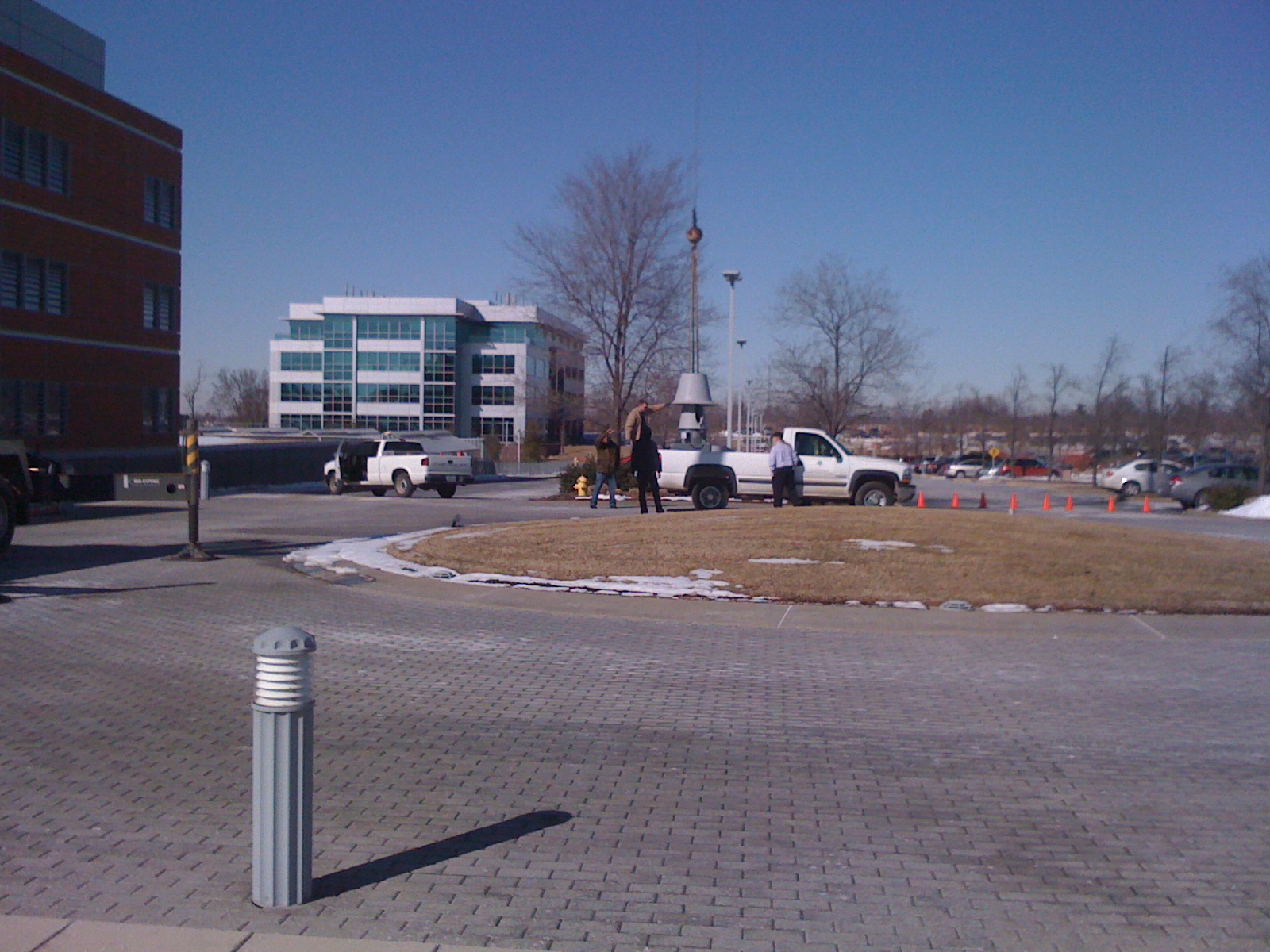

Almost all the internal construction is finished and we are on schedule for the ICPs to be installed at the beginning of March.
In other news, the weighing robot is almost finished. This week I visited Paul Armstrong at the USDAs Engineering and Wind Erosion Research Unit in Manhattan Kansas. Paul has built a robot that can take single corn and soybean seeds from a 48 well plate, weigh them and then put them in a specified digestion tube. This turns out to be one of the bottleneck steps in our sample prep, so the robot will save us hours every day. Here is a photo of the robot with Paul in the background....

and here is a front view......

Before you know it, we will be cranking through samples.
Almost all the internal construction is finished and we are on schedule for the ICPs to be installed at the beginning of March.
In other news, the weighing robot is almost finished. This week I visited Paul Armstrong at the USDAs Engineering and Wind Erosion Research Unit in Manhattan Kansas. Paul has built a robot that can take single corn and soybean seeds from a 48 well plate, weigh them and then put them in a specified digestion tube. This turns out to be one of the bottleneck steps in our sample prep, so the robot will save us hours every day. Here is a photo of the robot with Paul in the background....
and here is a front view......
Before you know it, we will be cranking through samples.
Monday, February 1, 2010
Maize Grant Submitted
In collaboration with Owen Hoekenga (Boyce Thompson Institute/USDA-ARS/Cornell University), Mourad Ouzzani (Purdue University), Margaret Smith (Cornell University), and Paul Anderson (Danforth Center) I just submitted a grant to the NSF-Plant Genome Research Program entitled "Mineral Nutrient Gene Discovery and Gene X Environment Interactions Using the Nested Association Mapping Population in Maize".
Here is the abstract:
Maize is the most widely adapted and adopted crop on the planet. This is largely due to the amazing degree of genetic and phenotypic diversity that can be harnessed into adaptation to local conditions. While progress has been made in some aspects of adaptation, e.g. flowering time, little progress has been made with respect to adaptation to soil conditions at the molecular and genetic levels. This is ironic given the importance of plant-soil interactions as they relate to agricultural efficiency, sustainability and productivity. We will utilize the Nested Association Mapping (NAM) population, a unique and powerful genetic resource, to identify genes controlling the elemental composition (the ionome) of maize grain. We will measure the levels of 20 different elements: P, Ca, S, K, Mg, Sr, Rb (macronutrients or their chemical analogs); B, Cu, Fe, Zn, Mn, Co, Ni, Mo (micronutrients of significance to plant and human health); Na, Al, As, Se and Cd (minerals causing agricultural or environmental problems). We will leverage grain samples from the 5,000 recombinant inbred lines that constitute the NAM population, which have already been grown at four different locations with widely different soils. One expected outcome of our project is the identification, at single gene resolution, of loci and alleles that alter the accumulation of the mineral nutrients and toxic elements from different soil conditions. We will confirm these results and identify potential causative polymorphisms by association analysis. For 20 selected loci, we will create Heterogeneous Inbred Families (HIFs) that an extended team of collaborators will help us to evaluate in multiple soil environments, which we will select based upon screening soil samples provided by our extended team. The HIFs will confirm the predicted allelic affects and allow us investigate the interactions between genetic and environmental factors to determine grain quality. Additional outcomes for our project will be the identification of hundreds of genetic loci and dozens of nucleotide polymorphisms that determine the mineral nutritional content of maize grain. We will also gain a better understanding of how many of these genes interact with environmental factors.
Here is the abstract:
Maize is the most widely adapted and adopted crop on the planet. This is largely due to the amazing degree of genetic and phenotypic diversity that can be harnessed into adaptation to local conditions. While progress has been made in some aspects of adaptation, e.g. flowering time, little progress has been made with respect to adaptation to soil conditions at the molecular and genetic levels. This is ironic given the importance of plant-soil interactions as they relate to agricultural efficiency, sustainability and productivity. We will utilize the Nested Association Mapping (NAM) population, a unique and powerful genetic resource, to identify genes controlling the elemental composition (the ionome) of maize grain. We will measure the levels of 20 different elements: P, Ca, S, K, Mg, Sr, Rb (macronutrients or their chemical analogs); B, Cu, Fe, Zn, Mn, Co, Ni, Mo (micronutrients of significance to plant and human health); Na, Al, As, Se and Cd (minerals causing agricultural or environmental problems). We will leverage grain samples from the 5,000 recombinant inbred lines that constitute the NAM population, which have already been grown at four different locations with widely different soils. One expected outcome of our project is the identification, at single gene resolution, of loci and alleles that alter the accumulation of the mineral nutrients and toxic elements from different soil conditions. We will confirm these results and identify potential causative polymorphisms by association analysis. For 20 selected loci, we will create Heterogeneous Inbred Families (HIFs) that an extended team of collaborators will help us to evaluate in multiple soil environments, which we will select based upon screening soil samples provided by our extended team. The HIFs will confirm the predicted allelic affects and allow us investigate the interactions between genetic and environmental factors to determine grain quality. Additional outcomes for our project will be the identification of hundreds of genetic loci and dozens of nucleotide polymorphisms that determine the mineral nutritional content of maize grain. We will also gain a better understanding of how many of these genes interact with environmental factors.
Saturday, January 9, 2010
Non-technical summary of Ferroportin paper
Here is a non-technical summary of our recent Ferroportin paper in Plant Cell.
Iron (Fe) is an essential element for both plants and animals, with insufficient Fe causing reduced plant growth and severe human health effects including anemia. While the basic mechanisms that plants use to take up Fe from the soil is known, relatively little is known about how the Fe is moved through the root to the vasculature, which takes it up to the shoot. Here we characterize two genes related to the mammalian Fe transporter, Ferrroportin, FPN1 and FPN2, in the model plant Arabidopsis Thaliana. The two proteins are expressed in different cell layers and go to two different cellular locations. FPN1 is localized to the plasma membrane (the cells outer layer) and is expressed around the vasculature, suggesting that it is involved in loading Fe into the vasculature. FPN2 is localized to the vacuole, an internal storage compartment that performs a variety of functions, and is expressed in the outer root layers. This suggests that FPN2 is working to buffer the levels of Fe in these cells by sequestering Fe in the vacuole. Consistent with these roles, we show that lines where these genes are disrupted have altered responses to Fe deficient conditions. We also show that these genes are involved in the homeostasis of Co, which is chemically similar to Fe but can be toxic to plants.
you can find the paper here (also available from our publications page)
Iron (Fe) is an essential element for both plants and animals, with insufficient Fe causing reduced plant growth and severe human health effects including anemia. While the basic mechanisms that plants use to take up Fe from the soil is known, relatively little is known about how the Fe is moved through the root to the vasculature, which takes it up to the shoot. Here we characterize two genes related to the mammalian Fe transporter, Ferrroportin, FPN1 and FPN2, in the model plant Arabidopsis Thaliana. The two proteins are expressed in different cell layers and go to two different cellular locations. FPN1 is localized to the plasma membrane (the cells outer layer) and is expressed around the vasculature, suggesting that it is involved in loading Fe into the vasculature. FPN2 is localized to the vacuole, an internal storage compartment that performs a variety of functions, and is expressed in the outer root layers. This suggests that FPN2 is working to buffer the levels of Fe in these cells by sequestering Fe in the vacuole. Consistent with these roles, we show that lines where these genes are disrupted have altered responses to Fe deficient conditions. We also show that these genes are involved in the homeostasis of Co, which is chemically similar to Fe but can be toxic to plants.
you can find the paper here (also available from our publications page)
Tuesday, December 22, 2009
Again: Baxter lab looking for first non-Baxter member
I am looking to hire the first member of the Baxter lab, the technician who will run the ionomics facility. Here is the ad:
The U.S. Department of Agriculture (USDA), Agricultural Research Service (ARS), Plant Genetics Research Unit in St. Louis, Missouri is seeking applications for a permanent, full-time PHYSICAL SCIENCE TECHNICIAN, GS-07/08/09 to provide support with the operation of a high-throughput elemental profiling facility centered around inductively coupled plasma spectrophotometers. Salary is commensurate with experience (38,117 – 60,612 per year), plus benefits. US Citizenship is required. Candidates must request a copy of the vacancy announcement (ARS-X10W-0048) by either calling 301-504-1583 or by copying the full text announcement from the http://www.afm.ars.usda.gov/divisions/hrd/vacancy/VAC2.HTM website. Candidates must submit specific information as outlined in the vacancy announcement. Applications must be received by the closing date of January 11, 2010. The USDA-ARS is an equal opportunity provider and employer.
Please spread the word!
The U.S. Department of Agriculture (USDA), Agricultural Research Service (ARS), Plant Genetics Research Unit in St. Louis, Missouri is seeking applications for a permanent, full-time PHYSICAL SCIENCE TECHNICIAN, GS-07/08/09 to provide support with the operation of a high-throughput elemental profiling facility centered around inductively coupled plasma spectrophotometers. Salary is commensurate with experience (38,117 – 60,612 per year), plus benefits. US Citizenship is required. Candidates must request a copy of the vacancy announcement (ARS-X10W-0048) by either calling 301-504-1583 or by copying the full text announcement from the http://www.afm.ars.usda.gov/divisions/hrd/vacancy/VAC2.HTM website. Candidates must submit specific information as outlined in the vacancy announcement. Applications must be received by the closing date of January 11, 2010. The USDA-ARS is an equal opportunity provider and employer.
Please spread the word!
Tuesday, December 1, 2009
Ivan featured in Danforth center newsletter
A short feature on me in the Danforth newsletter (see page 3). Bonus action shot of me actually working in the lab!
Subscribe to:
Posts (Atom)